Сім Променів
  • Про типосинтез
  • 4 стилі взаємодії
  • Описи типів
    • 1 - Сенсорика екстравертна
    • 2 - Сенсорика інтровертна
    • 3 - Емоції екстравертні
    • 4 - Емоції інтровертні
    • 5 - Мислення екстравертне
    • 6 - Мислення інтровертне
    • 7 - Інтуїція екстравертна
    • 8 - Інтуїція інтровертна
  • Відносини
    • Дуальні відносини
      • Se - Ni
  • Типи і архетипи
  • Контакти


FOUR INTERACTION STYLES 

Since childhood, we all have certain patterns of behavior, certain preferences and, in general, a certain attitude towards life. We all express ourselves in different ways and influence others in different ways. Often we cannot understand the behavior of other people, and they cannot understand ours. Moreover, sometimes we cannot understand what is driving our own behavior.

In order for individual characteristics to be used with benefit, and not to become a barrier in relationships between people, it is worth understanding what goals, motivations and beliefs underlie people's behavior. Understanding your own interaction style and the style of other people contributes to more effective communication and helps to avoid many misunderstandings.

There are four interaction styles
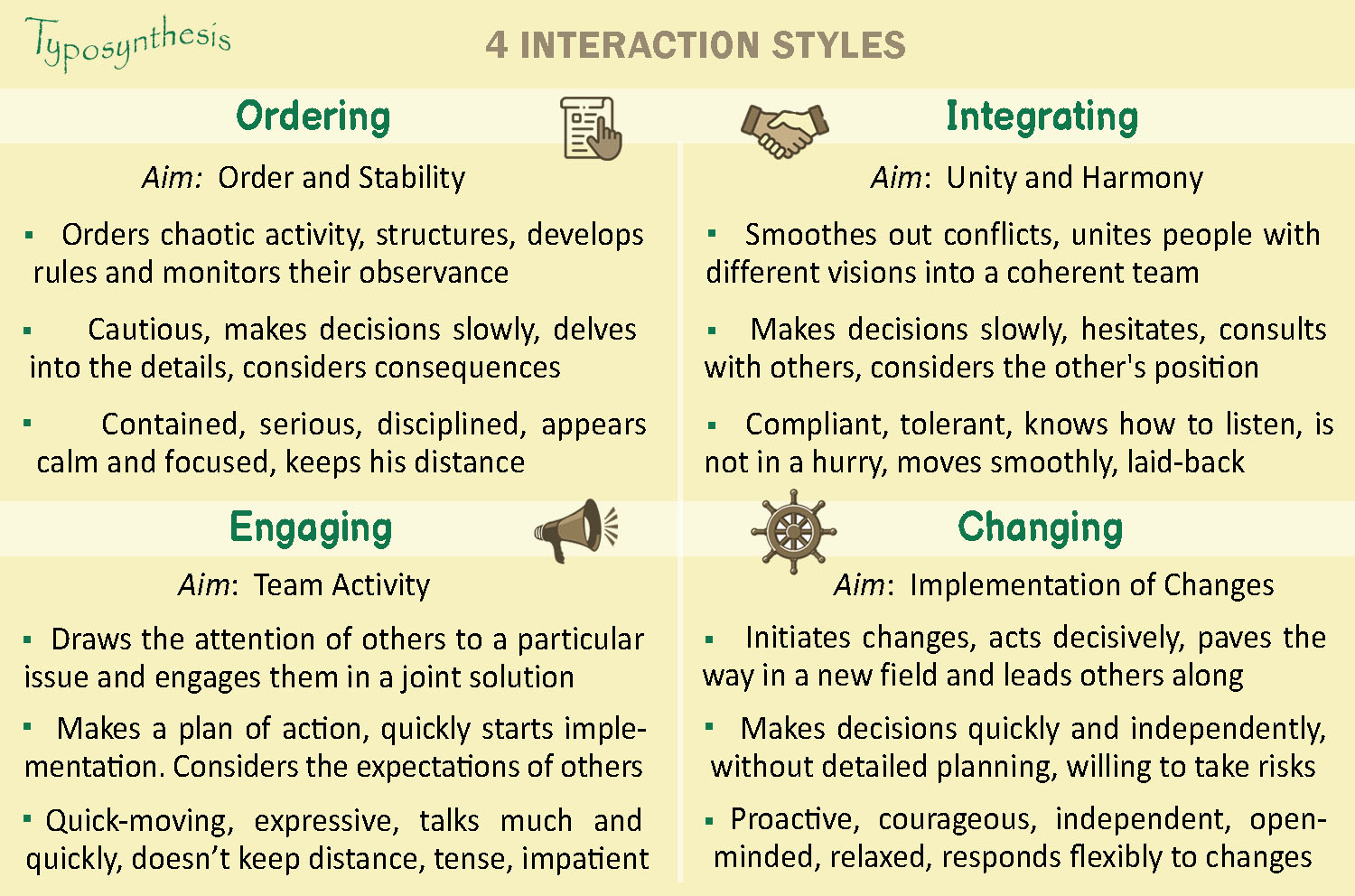
Different styles are characterized by different aims, and different strategies are applied to achieve these aims.

• Integrating style. People with the Integrating style are driven to create unity and harmony. They smooth out conflicts, help find consensus, unites people with different visions into a coherent team, create a harmonious environment.

• Changing style. People with the Changing style are driven to implement changes. They destroy old systems and patterns, initiate changes, act decisively and confidently, pave the way in a new field and lead others along.

• Engaging style. People with the Engaging style are driven to organize collaborative activities. They draw the attention of others to a particular issue and engage them in a joint discussion and activity.

• Ordering style. People with the Ordering style are driven to ensure order and stability. They order chaotic activity, structure, create a system, develop rules and monitor their observance.

More information here psyholistic.top

*      *      *      *      *

There are two pairs of psychic attitudes that underlie the four interaction styles:

• Two opposite attitudes that define one’s favorite way to respond and operate;

• Two opposite attitudes that define where someone gets their energy from and how one puts out energy.

4 interaction styles

 українською >>

Socionics and MBTI

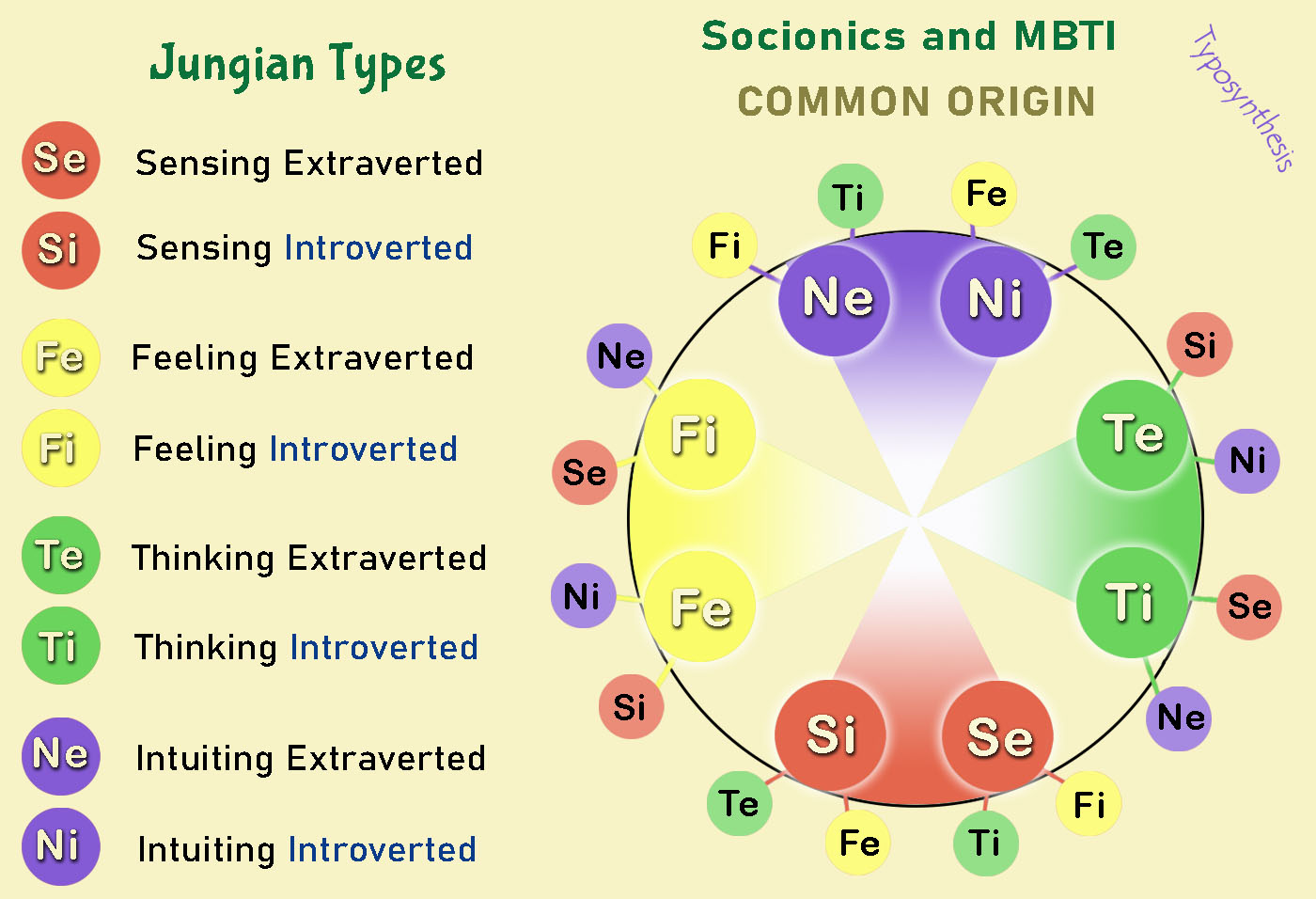
Socionics and MBTI are typological models based on Carl Jung's typology. Both models, the Socionics and the MBTI, have 16 personality types. 

It would seem that these two models should be identical, but as it turned out, they are very different from each other. While the EXTROVERTED types in the MBTI model roughly correspond to the EXTROVERTED types in the Socionics model, there are significant differences between the INTROVERTED types of both models.

To understand the difference between socionics and MBTI, we need to look at their foundations, which are based on Jung's typology. There are only four basic parameters in Jung's typology:
* Sensation/Intuition,
* Feeling/Thinking,
* Extraversion/Introversion,
* Rationality/Irrationality.

If one of these parameters is violated, the system will not work.

Читати далі...
4 interaction styles


PLANNED AND SPONTANEOUS APPROACHES

There are two opposite person’s approaches to life: planned and spontaneous.

People who are dominated by a planned approach to life prefer an orderly, structured environment with a certain system of regulations. They are organized and consistent, make sure that everything goes according to plan, feel at ease when everything is known in advance. Their strategy is PLANNING AND CONTROL.

People who have a predominantly spontaneous approach to life are focused on direct perception. They believe that life is changeable and unpredictable, are open to new information and experience, act situationally, according to circumstances. Their strategy is to BE FLEXIBLE AND LIVE IN THE FLOW.

The table below shows the typical characteristics of the two approaches.

Читати далі...
  1. Головна
  2. 4 interaction styles
  • About Typosynthesis
  • 4 interaction styles
  • The Eight Type Descriptions
    • Sensing Extraverted
    • Sensing Introverted
    • Thinking Introverted
    • Intuiting Introverted
    • Differences between ...
      • Se and Si
  • Prototypes
  • Vertical development
  • Contact Us

Date Loading...
Tokyo
JP JP
00:00
London
GB GB
00:00
Paris
FR FR
00:00
Kyiv
UA UA
00:00
Washington
US US
00:00

Seven Rays Consulting Group © 2026
Sign In
  • Про типосинтез
  • 4 стилі взаємодії
  • Описи типів
    • 1 - Сенсорика екстравертна
    • 2 - Сенсорика інтровертна
    • 3 - Емоції екстравертні
    • 4 - Емоції інтровертні
    • 5 - Мислення екстравертне
    • 6 - Мислення інтровертне
    • 7 - Інтуїція екстравертна
    • 8 - Інтуїція інтровертна
  • Відносини
    • Дуальні відносини
      • Se - Ni
  • Типи і архетипи
  • Контакти