
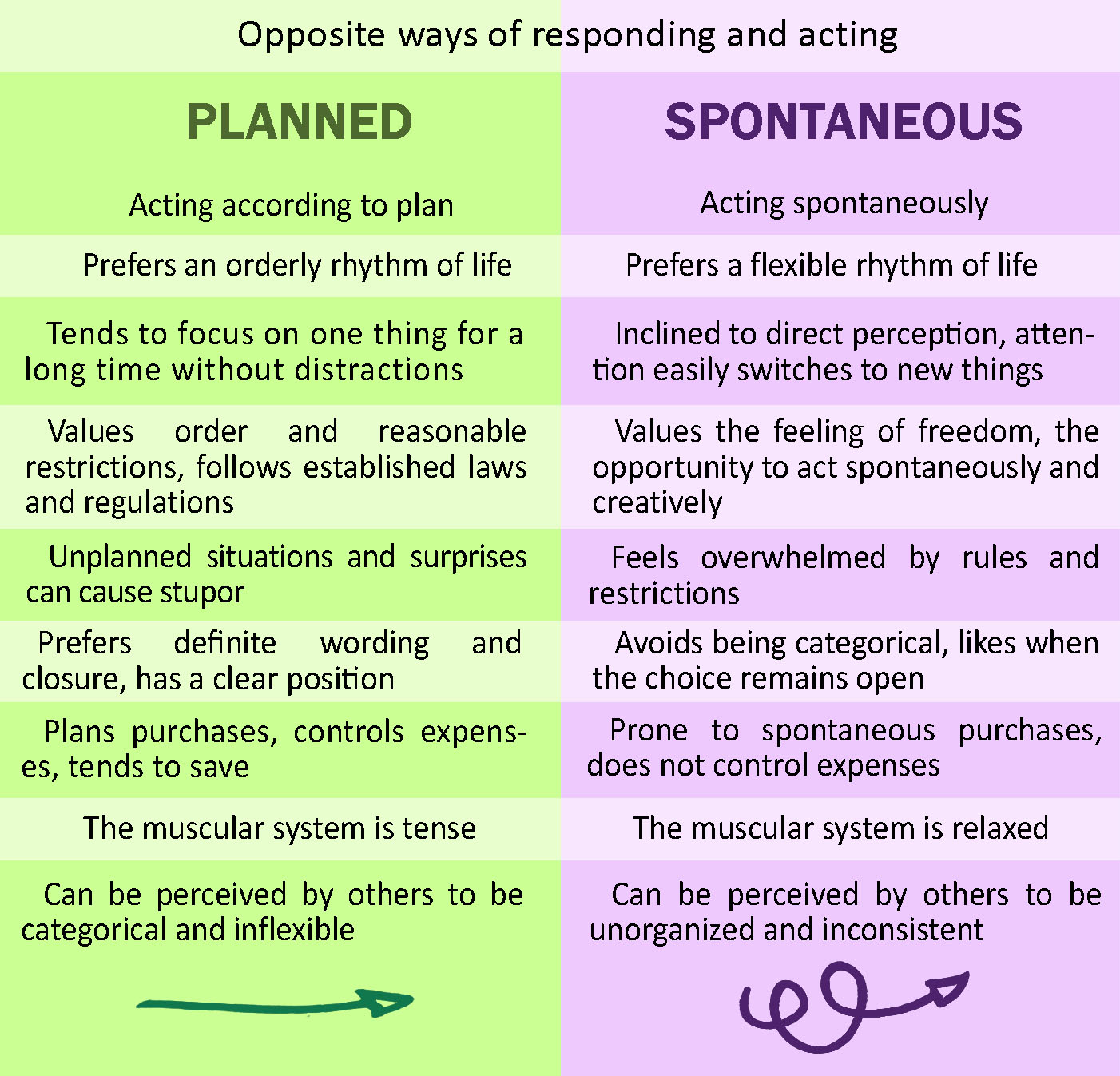
People with the planned approach tend to have a regular rhythm of life, like to have a plan for all occasions, have clear goals and consistently approach them. They can focus on one task for a long time temporarily limiting other needs and without being distracted.
People with the spontaneous approach prefer a flexible rhythm of life, can make plans, but rarely stick to them. They do not tend to concentrate on one thing for a long time, their attention easily switches to new information.
Due to the tendency to in-the-moment perception, people with the spontaneous approach easily adapt to changing situations and quickly pick up new ideas. People with the planned approach also like changes, but changes must be planned. If circumstances change, they need time to get used to them and re-arrange their plans.
Example. Thomas and Claire decided to go to the cinema. Thomas (who has a spontaneous approach) is convinced that tickets can be purchased at the venue. And if they are not there, the plan can be changed: watch another movie or go to a cafe. Life will throw them the best option. However, Claire (who has a planned approach) is sure that tickets must be purchased in advance so that everything goes according to plan.
See more here psyholistic.top