
Socionics and MBTI
Socionics and MBTI are typological models based on Carl Jung's typology. Both models, the Socionics and the MBTI, have 16 personality types.
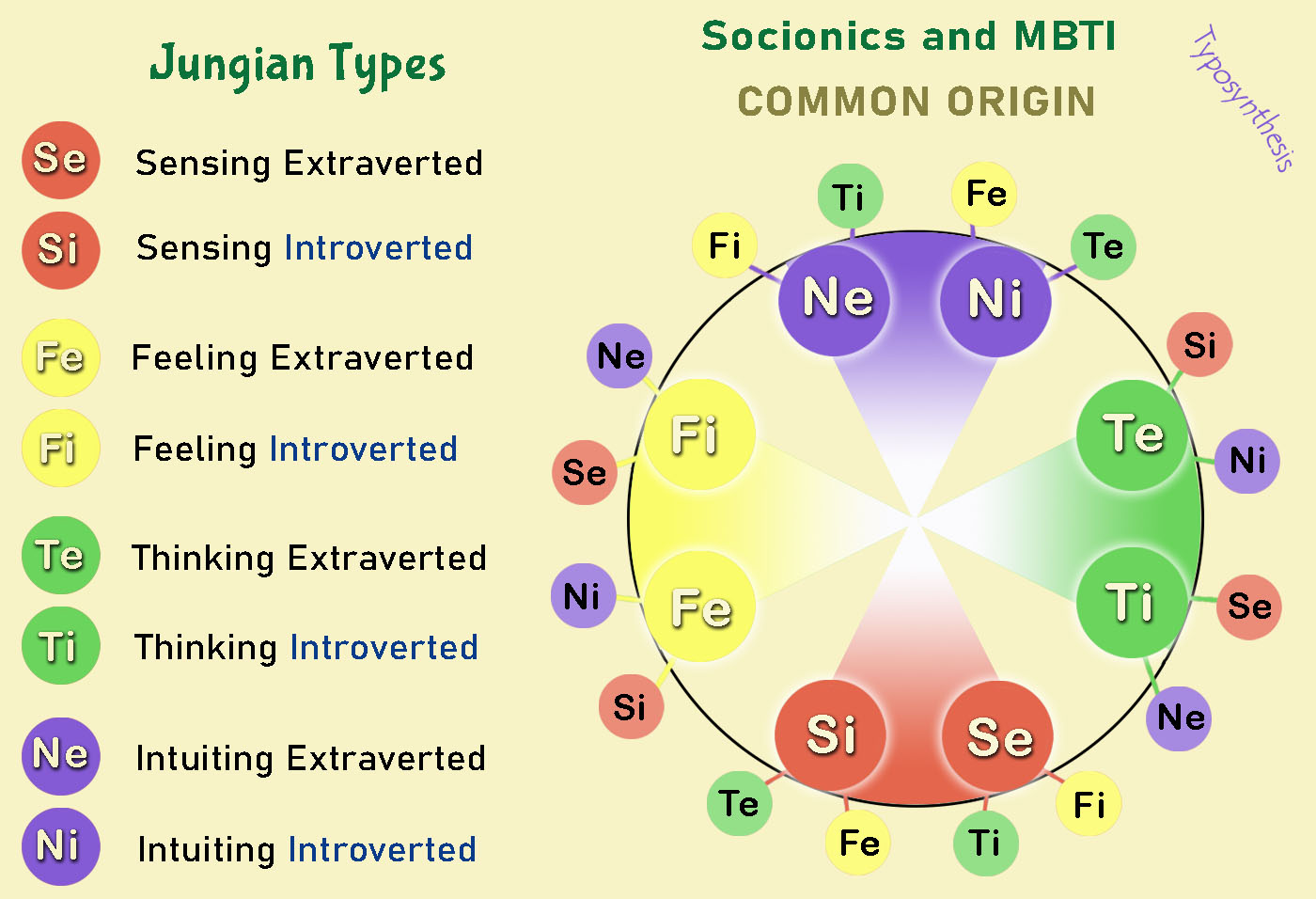
It would seem that these two models should be identical, but as it turned out, they are very different from each other. While the EXTROVERTED types in the MBTI model roughly correspond to the EXTROVERTED types in the Socionics model, there are significant differences between the INTROVERTED types of both models.
To understand the difference between socionics and MBTI, we need to look at their foundations, which are based on Jung's typology. There are only four basic parameters in Jung's typology:
* Sensation/Intuition,
* Feeling/Thinking,
* Extraversion/Introversion,
* Rationality/Irrationality.
If one of these parameters is violated, the system will not work.
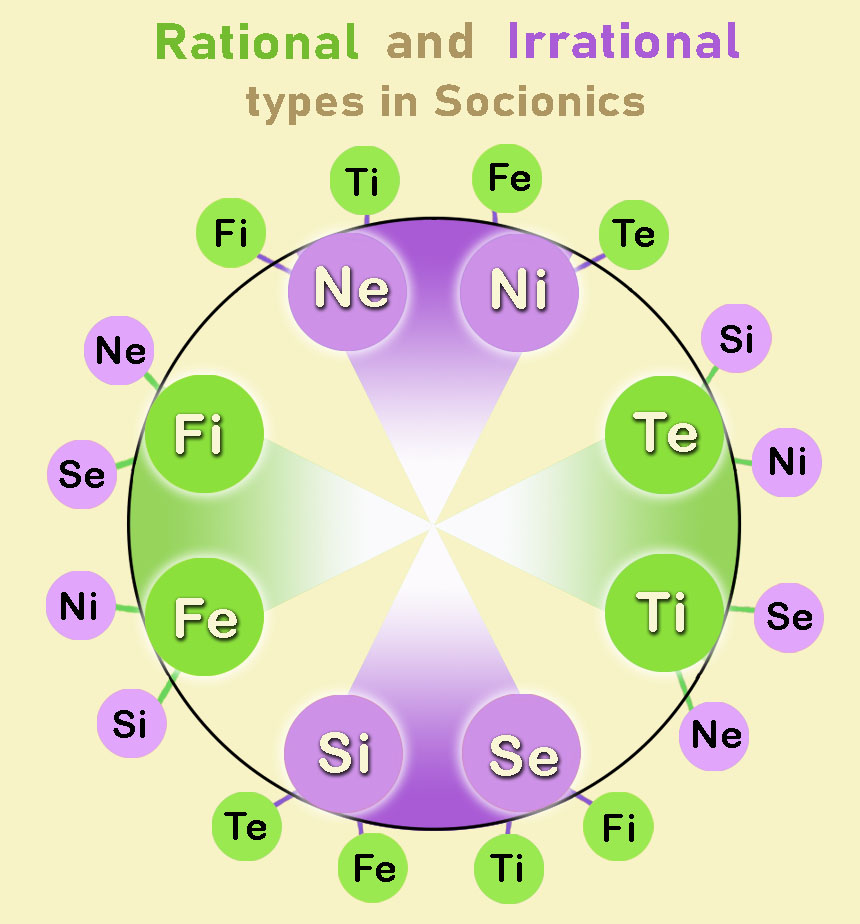
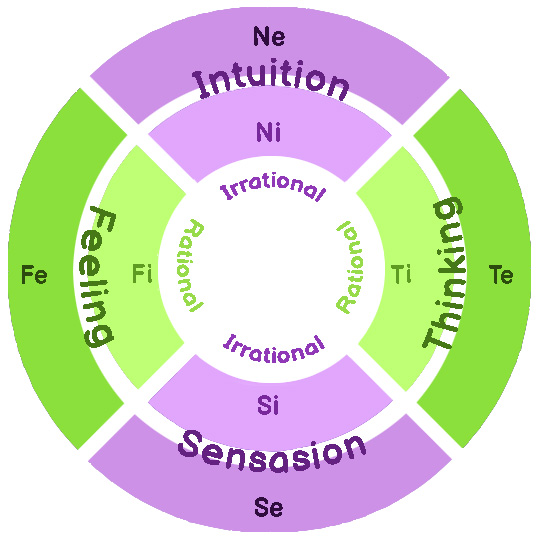 The biggest discrepancy between socionics and MBTI concerns the Jung's parameter Rationality/Irrationality. In his work "Psychological Types", Carl Jung divided all eight types (or eight function) into two groups: RATIONAL and IRRATIONAL. The four Jung's types (Se, Si, Ne, Ni) share common parameter IRRATIONALITY, and the other four types (Fe, Fi, Te, Ti) have a common parameter RATIONALITY. According to Jung, a type is rational if its main (dominant) psychic function is rational, a type is irrational if its main psychic function is irrational.
In the Chapter X of "Psychological Types" there are the follow sections:
B. The Extraverted Type
5. Recapitulation of Extraverted Rational Types
10. Recapitulation of Extraverted Irrational Types
C. The Introverted Type
5. Recapitulation of Introverted Rational Types
10. Recapitulation of Introverted Irrational Types
Rationality/Irrationality in socionics and MBTI
Socionics uses the Rationality/Irrationality parameter, which, according to socionics practitioners, is identical to the Jungian Rationality/Irrationality parameter.
The MBTI has the concept of Judging/Perceiving, which is considered by Socionics practitioners to be the same as Rationality/Irrationality. However, MBTI practitioners do not consider it the same. They believe that Judging/Perceiving refer only to whatever function the type shows in the outer world, i.e. the DOMINANT function for EXTRAVERTED types, and the AUXILIARY function for INTROVERTED types.
Let's compare what is meant by the concept of Rationality/Irrationality in socionics and Judging/Perceiving in MBTI.
• Manifestations of Judging/Perceiving in MBTI (Isabel Myersʼ Clusters for MBTI Form G)
Judging – Perceiving
Spontaneity: Contrast between a scheduled and a spontaneous lifestyle.
Planning: Contrast between longer-term planning and going with the flow.
Organizing: Organizing the situation at hand, as opposed to long-term planning.
Application: Contrast between enjoying meeting the goal and finishing, versus enjoying something that catches interest; or between working for duty or pleasure.
Obligations: Contrast between being more serious or casual about meeting obligations.
Isabel Myersʼ Rules for MBTI Form G Clusters
|
Judging |
Perceiving |
|
|
Spontaneity |
Live comfortably with schedules, routines and systems |
Enjoy the variety of frequent changes; want time free and uncommitted |
|
Planning |
Enjoy arranging for activities ahead of time; like to have plans settled |
Prefer not to cross a bridge before reaching it |
|
Organizing |
Organise a job before starting it |
Start projects without feeling a need to organise beforehand |
|
Application |
Learn more by persistent effort than by exploring what engages curiosity. Real satisfaction out of finishing whatʼs started |
Learn more by exploring what engages curiosity than by persistent effort. Work best at jobs requiring a variety of activities or adaptability to handle changes, emergencies |
|
Obligations |
Orderly, systematic |
Casual, easy–going |
Source: CAPT Research Papers; some text has been adapted by Peter Geyer (1)
* * *
• Manifestations of Rationality/Irrationality in socionics.
|
Rationality |
Irrationality |
|
Acting according to plan (Acts) |
Acting spontaneously |
|
Prefers an orderly rhythm of life |
Prefers a flexible rhythm of life |
|
Tends to focus on one thing for a long time without distractions |
Inclined to direct perception, attention easily switches to new things |
|
Values order and reasonable restrictions, follows established laws and regulations |
Values the feeling of freedom, the opportunity to act spontaneously and creatively, freedom of choice |
|
Unplanned situations and surprises can cause stupor |
Feels overwhelmed by rules and restrictions |
|
Prefers definite wording and closure, has a clear position |
Avoids being categorical, likes when the choice remains open |
|
Plans purchases, controls expenses, tends to save |
Prone to spontaneous purchases, does not control expenses |
|
Can be perceived by others to be categorical and inflexible |
Can be perceived by others to be disorganized and inconsistent |
See more about Rationality/Irrationality here >>>
As we can see, the manifestations of Rationality/Irrationality in Socionics are identical to the manifestations of Judgment/Perception in MBTI.
However, as we will see below, socionics and MBTI have opposite approaches to the definition of types associated with different applications of Rationality/Irrationality.
Let's take as an example the description of the type Crafter (ISTP) by David Keirsey (2)
The Crafter (ISTP). Excerpt from the description:
“The Crafter's tool artisanship is masterful, but it is also born of impulse rather than of deliberate purpose. For these Artisans, action is more enjoyable-and more effective-if it is unplanned, serving no purpose other than the doing. ISTPs prefer their actions to be spontaneous and unfettered; they want to follow their own lead, and to have their own impulses not subject to rules, regulations, or laws. Indeed, Crafters can be fiercely insubordinate, seeing hierarchy and authority as unnecessary and even irksome. It is not so much a matter of going against regulations as it is simply ignoring them, and not allowing them to influence execution. ISTPs must be free to do their thing, varying each next move as the urge strikes them, and they are proud of their ability to make the next move skillfully. In a sense, Crafters do not work with their tools, but play with them on impulse and not on schedule. If an externally imposed schedule coincides with their impulse, fine; if not, so much the worse for the schedule.”
From this description, it is clear that the Crafter (ISTP) belongs to the Irrational type. According to Jung, a type is irrational if its main (dominant) psychic function is irrational. The irrational functions are Sensation and Intuition. Therefore, the main psychic function of the type Crafter (ISTP) should be Sensasion or Intuition. Socionics classifies the type Crafter as a type with the main function introverted Sensasion. This is fully consistent with Jung's concept of rationality/irrationality.
This is what Carl Jung says about the Introverted Sensation Type:
It is an irrational type, inasmuch as its selection among occurrences is not primarily rational, but is guided rather by what just happens. (3)
However, MBTI classifies the type Crafter (ISTP) as a type with the main function - introverted Thinking, which very surprises socionists. After all, according to Jung's typology, Thinking is a rational function. It is not clear how a rational function can be the dominant function of an irrational type.
As in the MBTI community, David Keirsey's description of ISTP is known to be problematic, I suggest you also consider Otto Kroeger's description of the ISTP. (4)
«ISTP - Ready to Try Anything Once.
ISTPs are especially skilled with their hands and often get satisfaction from accomplishments that are both tactile and immediate. When something—as opposed to someone—needs attention, the ISTP’s powers of observation (related to both their Sensing and Perceiving preferences) make it possible for them to plunge into the task at hand without feeling it necessary to follow procedures or read directions.
ISTPs can often be enigmas, especially to Extraverts and Judgers, who find their unpredictability and apparent social indifference so disturbing that they may try to change them. Not only will the ISTP resent such impositions, he or she may get an inner thrill or satisfaction in not behaving according to expectations, always remaining somewhat mysterious... Relating to ISTPs can be both fun and confusing—fun because of their spontaneous, easygoing view of life, confusing because of their mixed communication messages.
ISTP parents do not believe in planning. They tend to wait and see what each day brings, and then do what is needed at the time. ISTPs, in their general living and certainly in parenting, know that the best-laid plans go awry. Given that, the plan is not to have a plan, and expect that things will work out for the best as a result.»
From this description, it is also clear that the ISTP belongs to the Irrational type.
According to Jung, a type is rational if its main (dominant) psychic function is rational, a type is irrational if its main psychic function is irrational.
The parameter of Rationality/Irrationality in Socionics completely coincide with the parameters of Judging/Perceiving in the MBTI for EXTRAVERTED types. As for introverted types, MBTI practitioners believe that Judging/Perceiving refer only to whatever function the type shows in the outer world, i.e. the DOMINANT function for EXTRAVERTED types, and the AUXILIARY function for INTROVERTED types.
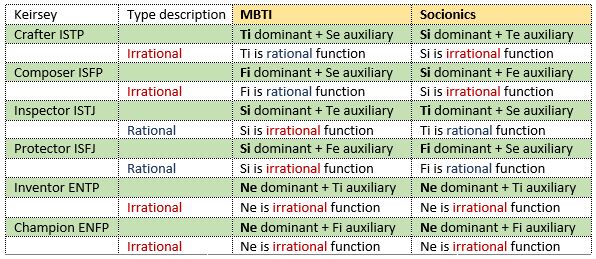
Due to the different use of the parameter rationality/irrationality, the Crafter ISTP type, socionics refers to Jungian Sensing Introverted, and MBTI refers Crafter to Jungian Thinking Introverted.
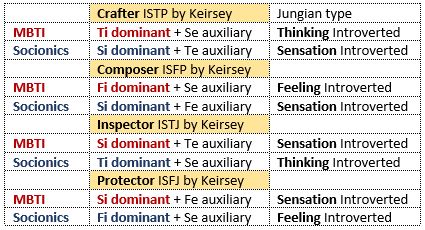
Carl Jung describes eight types, half of which are RATIONAL and half are IRRATIONAL. The introverted types Fi and Ti are RATIONAL. Note, when Carl Jung writes that the Introverted Thinking Type is rational, he does NOT mention that the rationality/irrationality of this type is determined by the auxiliary function. The description of the Introverted Thinking Type does not include the auxiliary function at all.
Moreover, Carl Jung emphasizes that the rationality/irrationality of a type is determined by the main function of the type:
“Thinking, as primary function, can readily pair with intuition as auxiliary, or indeed equally well with sensation… they are functions of perception, affording welcome assistance to thought. As soon as they reached the same level of differentiation as thinking, they would cause a change of attitude, which would contradict the tendency of thinking. For they would convert the judging attitude into a perceiving one; whereupon the principle of rationality indispensable to thought would be suppressed in favour of the irrationality of mere perception.” (6)
John Beebe, American psychiatrist and Jungian analyst, also distinguishes between rational and irrational functions. In his essay ‘Understanding consciousness through the theory of psychological types’ (7) he writes:
‘The archetypal analysis of the first four functions provided the basis for the model of type I was able to present at the Conference in 1983. We might note several features of this model:
* It agrees with Myers and the MBTI counselors that if the superior function is introverted the auxiliary will be extraverted and vice versa.
* The model asserts, with Jung and subsequent Jungians, that if the superior function is irrational the auxiliary will be rational, and vice versa.
* Following the Jungian tradition, the model maintains that if the superior function is rational, the inferior will likewise be rational; if the superior function is irrational, the inferior function will also be irrational.
* The model therefore defines two axes of consciousness, one between the superior and inferior functions (spine), the other between the auxiliary and tertiary functions (arms). If the spine is rational, the arms will be irrational and vice versa‘
Here is what John Beebe writes about Judging/Perceiving in MBTI (7):
‘I addressed the subject of type incompatibility in my first full-length essay on the role types play in transference, countertransference, and the therapeutic interaction (Beebe, 1984). In that publication, I recommended that analysts try to determine for each of a client’s four functions whether that function is being used in an introverted or an extraverted way. … In that same essay, I looked at the other potential basis of incompatibility Jung discusses, and that Isabel Briggs Myers explores at great length in her book. That, for Jung, is whether the person’s superior function is rational (his term for the evaluative functions, thinking and feeling) or irrational (his term for the perceptive functions, sensation and intuition). Because she was working out a type assessment instrument that focused on easily identifiable behaviors in the outer world, Myers felt that she had to get at the difference between rational and irrational modes of consciousness by looking at the individual’s leading extraverted function, whether superior or auxiliary. On the Myers–Briggs Type Indicator (MBTI), this extraverted function is therefore given a letter code, J or P, to indicate whether it is a judging function (her way of referring to Jung’s rational functions) or a perceiving function (her way of identifying Jung’s irrational functions).
For me, Jung’s approach is the more psychological. When assessing type compatibility between people, I prefer to look at each individual’s vertical axis, or spine of consciousness, which connects the superior and inferior function, rather than privileging extraversion. Thus, I noted early on my incompatibility with an introverted feeling type companion (we were both ‘P’s according to the MBTI system, since his leading extraverted function was his auxiliary extraverted sensation). I found that our spines tended to cross: he often heard my perceptions for judgments, just as I mistook his judgments for perceptions, a source of many misunderstandings.’
* * *
I observe a sad and unscientific situation in the MBTI world: MBTI experts say that Jung's concept of rationality/irrationality DOESN’T correspond to the MBTI concept of judging/perceiving, and at the same time not a single MBTI specialist can say what Jung's concept of rationality/irrationality is.
How can one say that MBTI concept of judging/perceiving doesn’t correspond to Jung's concept of rationality/irrationality if no one knows what Jung's concept of rationality/irrationality is ?
I invite you to discuss this topic on the forum www.typologycentral.com
Thread – typologycentral.com/threads/jungian-concept-of-rationality-irrationality
Thread – typologycentral.com/threads/jung-j-p-rational-irrational-versus-mbti-j-p
or on the forum www.personalitycafe.com
Thread – personalitycafe.com/threads/irrational-vs-rational-judging
Why MBTI does not have a types compatibility theory while the concept of intertype compatibility works well in Socionics ?
Some experts have tried to identify compatible personality types based on the Myers-Briggs test. However, no exhaustive research has been conducted to validate the scales or establish a degree of compatibility. (5) MBTI manual have no types compatibility theory.
Socionics goes more in depth than MBTI, as it allows to describe and forecast not only behavior of the 16 types, but relationships between such types as well. Intertype relations refer to the patterns of functional interaction between two types. Socionics describes which type (and why) is more suitable us for business, which type is more suitable for leisure, which type is more suitable for long-term family relationships, and which type is more suitable for a short, stormy romance.
Using the example of compatibility for long-term family relationships, I will show why the concept of intertype relationships has failed in MBTI.
According to the Socionic concept, compatibility in long-term family (or romantic) relationships is ensured by the complement of a dual function. For example, for Si-dominant type the dual function will be Ne, for Te-dominant type the dual function will be Fi. John Beebe calls the dual function Anima-Animus. So, for Si-dominant type, Ne-dominant type will be most compatible.
For Intertype relations theory to work, one need to correctly identify the type. If one is mistaken about one's own type, the Intertype relations theory will not work.
Let's consider how Socionics and MBTI determine the Si-dominant type. Si-dominant type can have an auxiliary function Fe or an auxiliary function Te: Si dom + Fe or Si dom +Te.
Practitioners of socionics believe that among the 16 types described by David Keirsey, the Si-dominant types are Crafter (ISTP) and Composer (ISFP). The Crafter has the dominant function Si and the auxiliary function Te, the Composer has the dominant function Si and the auxiliary function Fe. Since, for the Si-dominant type, Ne-dominant type will be most compatible, the most compatible for the Crafter is the Ne+Fi type (ENFP), and for the Composer the most compatible is the Ne+Ti type (ENTP).
But for MBTI the picture is completely different. Practitioners of MBTI believe that among the 16 types described by David Keirsey, the Si-dominant types are Inspector (ISTJ) and Protector (ISFJ). From the point of view of Socionics, the relationship between the Inspector (Ti+Se) and the ENFP is the least favorable.
Upon closer acquaintance with the MBTI, one can see that in MBTI separate functions are not distinguished, each of the 16 types is described as a whole, without division into functions. In the MBTI type descriptions, it is not clear which function is described: dominant, auxiliary, or another. In contrast to MBTI, socionics, in addition to the general description of the type, also indicates the role of each of the 8 functions in the manifestation of this type. For example, for the type Crafter, each of the 8 functions is described separately and explained how exactly it manifests itself in the behavior of the type Crafter. Moreover, socionics describes what relationships the type Crafter can have with each of the 16 types, and explains how each of the 8 functions of the type Crafter interacts with each of the 8 functions of the other type.
Anzhelika Zabava, Socionics Practitioner
* * *
1 - CAPT - Center for Applications of Psychological Type www.capt.org Peter Geyer C.G.Jung's psychological types, the MBTI, and ideas of social adjustment. March 2014 >>>
2 - David Keirsey «Please Understand Me»
3 - Carl Jung. Psychological types. X - general description of the types. C. The Introverted Type. 7. The Introverted Sensation Type
4 - Otto Kroeger, Typewatching Profile, full description (PDF file) is here >>>
6 - Carl Jung. Psychological types. X - general description of the types. C. The Introverted Type. 11. The Principal and Auxiliary Functions
7 – Beebe John (2004).Understanding consciousness through the theory of psychological types. In Analytical Psychology: Contemporary Perspectives in Jungian Analysis, edited by Joseph Cambray and Linda Carter, pp.83–115. Hoveand New York: Brunner Routledge.
Last undating 12.10.2025.